The Bottom Line
I run this in my own home. That's the short version of this review. The longer version: after buying a HEPA air purifier and feeling good about our indoor air, I learned that HEPA filters catch exactly zero of the chemical gases floating around your house. The formaldehyde off-gassing from new furniture, the VOCs from paint, the chemicals in cleaning products, the fumes from building materials - your HEPA purifier lets all of it pass right through. The TerraBloom inline fan and activated carbon filter combo is what actually catches that stuff. It's not a replacement for a HEPA purifier. It's the missing companion piece.
The Gap in Your Air Purifier
Here's what most parents don't know
HEPA filters catch particles - dust, pollen, pet dander, mold spores. Anything solid floating in the air. But chemical gases are not particles. Formaldehyde, VOCs, paint fumes, off-gassing from new furniture, cleaning product chemicals - these are invisible gas molecules that pass straight through a HEPA filter like it isn't there. To catch gases, you need activated carbon. Most HEPA purifiers include a thin carbon layer, but it's nowhere near enough for real chemical filtration. You need a dedicated, thick carbon bed.
This isn't a niche concern. The EPA estimates that indoor air can be 2 to 5 times more polluted than outdoor air. A significant portion of that indoor pollution is chemical gases, not particles. New furniture, mattresses, carpet, paint, cleaning products, building materials during renovation - all of these release volatile organic compounds (VOCs) into your home continuously. If you've ever noticed a "new furniture smell" or "new carpet smell," you're breathing VOCs.
For families with new babies, this matters even more. A newly furnished nursery can have elevated VOC levels from the crib, changing table, dresser, paint, and carpet - all off-gassing at the same time into a small room where your baby sleeps 14 to 17 hours a day.
What Is It
The TerraBloom 6-inch combo is two components that work together: an inline duct fan and a cylindrical activated carbon filter. The fan pulls air through the carbon filter, which adsorbs chemical gases and odors. It's designed to connect to standard 6-inch ducting and can be installed in a variety of ways - inline with existing HVAC ductwork, in a closet or utility space with ducting to and from the room, or even as a standalone unit with short duct runs.
This is not a pretty countertop appliance. It's a utilitarian, industrial-style setup that lives out of sight. Think of it like a water filter under your sink - you don't look at it, but it's always working. If aesthetics matter, this isn't going in your living room on display. It goes in a closet, attic, basement, or laundry room and does its job quietly.
How It Works
The system has two main components:
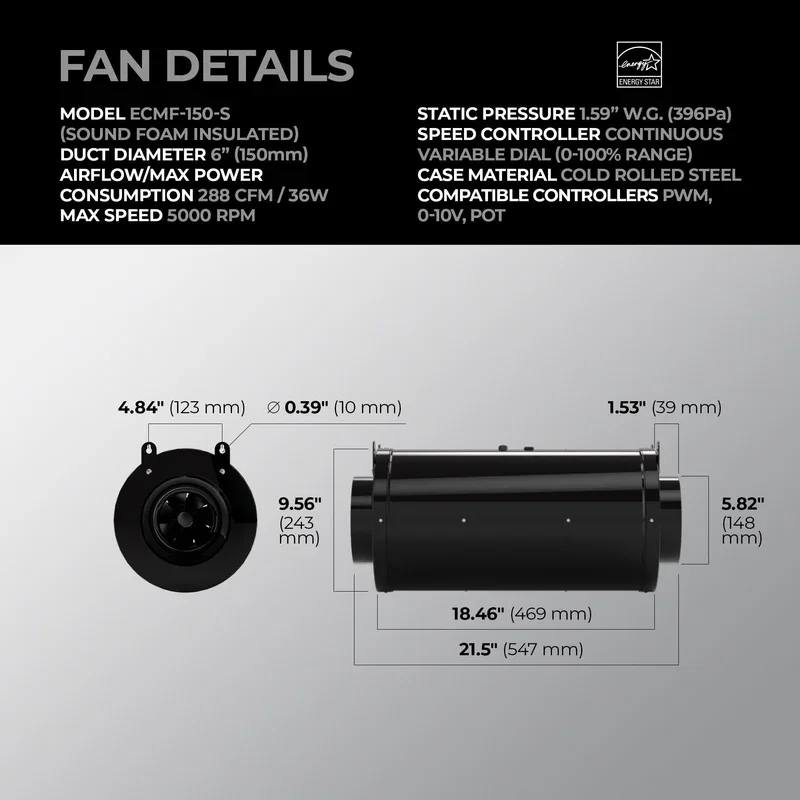
EC Inline Fan
Electronically commutated (EC) motor that's quieter and more energy-efficient than traditional AC motors. Variable speed control lets you dial in exactly the airflow you need. Runs at ~31 dBA on low.
Activated Carbon Filter
46mm-thick bed of Australian RC-412 virgin activated carbon. Adsorbs VOCs, formaldehyde, paint fumes, chemical odors, cooking gases, and other airborne chemicals as air passes through.
How activated carbon works: Unlike HEPA, which physically traps particles in fiber mesh, activated carbon uses a process called adsorption. Gas molecules stick to the massive surface area of the carbon (1 gram of activated carbon has 3,000+ square meters of surface area). Once the carbon is saturated, it stops working - which is why the filter needs periodic replacement.
The 46mm carbon bed is a key spec. Many carbon filters (including the thin carbon layers in HEPA purifiers) use just a few millimeters of carbon. The thicker the bed, the more contact time between the air and carbon, and the more effective the filtration. TerraBloom's 46mm bed is significantly thicker than most competitors in this price range.
What It Does Well
- 46mm activated carbon bed - thicker than most competitors, more contact time for better gas removal
- EC motor - quieter, more efficient, and longer-lasting than AC motors
- ~31 dBA on low - quiet enough that you forget it's running
- ETL and Energy Star certified - independently tested for safety and efficiency
- Variable speed control - adjust airflow from whisper-quiet to maximum
- Australian RC-412 virgin carbon - high-quality carbon for better adsorption
- Removes what HEPA can't - VOCs, formaldehyde, chemical gases, paint fumes, cleaning product chemicals
The EC motor is worth calling out. Most inline fans at this price use AC motors, which are louder, less efficient, and generate more heat. EC motors are the kind of upgrade that you don't appreciate until you've lived with a loud AC inline fan. On low speed, the TerraBloom is genuinely quiet - I can't hear it from the next room.
Energy Star certification means it's been independently verified for energy efficiency. ETL certification means it's been safety tested to UL standards. Both matter when you're running something 24/7 in your home.
What It Doesn't Do
No particle filtration. This is critical to understand. The TerraBloom does not remove dust, pollen, pet dander, mold spores, or any solid particles from the air. It removes gases only. You still need a HEPA air purifier for particles. Think of it this way: HEPA handles the solid stuff, carbon handles the invisible chemical stuff. Together, they cover everything.
Not a plug-and-play appliance. Unlike a Levoit or Coway that you take out of the box and plug in, the TerraBloom requires some setup. You need 6-inch ducting, clamps, and a plan for where to route the air. It's not difficult - anyone comfortable with basic home projects can do it in an hour - but it's not "unbox and press the power button" simple.
Not decorative. The fan and filter are industrial-looking cylinders. They're designed to be hidden in a closet, utility room, attic, or basement. If you need something that looks nice in the living room, this isn't it.
Carbon has a lifespan. Once the activated carbon is saturated with chemicals, it stops filtering. You'll need to replace the carbon filter every 12 to 18 months. The good news is you can tell when it's time - if odors start getting through that it used to catch, the carbon is spent.
Replacement Costs
| Item | Cost | Frequency |
|---|---|---|
| TerraBloom 6" Fan + Filter Combo | ~$170–$220 | One-time |
| Replacement Carbon Filter (6") | ~$50–$70 | Every 12–18 months |
| Ducting and Clamps | ~$15–$30 | One-time |
| Electricity (~50W max) | ~$5/month | Ongoing |
| Annual operating cost | ~$95–$130/year | Ongoing |
The annual cost is higher than a basic HEPA purifier because the carbon filters cost more to replace. But consider what you're getting: removal of invisible chemical gases that your HEPA purifier completely ignores. If you've invested in a HEPA purifier to protect your family's air, the TerraBloom completes the picture for roughly $8 to $11 per month.
What We Like
- Removes VOCs, formaldehyde, and chemical gases that HEPA purifiers miss entirely
- 46mm carbon bed - significantly thicker than competitors in this price range
- EC motor is genuinely quiet (~31 dBA on low) and energy efficient
- ETL and Energy Star certified - independently tested
- Variable speed control for fine-tuning noise vs airflow
- High-quality Australian RC-412 virgin activated carbon
- Fills a critical gap in home air quality that almost nobody talks about
What Could Be Better
- Requires installation - not a plug-and-play appliance
- Industrial look - needs to be hidden in a closet or utility space
- Does not remove particles (dust, pollen, dander) - you still need a HEPA purifier
- Carbon filter replacement is $50 to $70 every 12 to 18 months
- Need to purchase ducting and clamps separately
- No smart features, app, or air quality sensor
How It Compares
The TerraBloom doesn't compete directly with standard air purifiers because it solves a different problem. But here's how it fits alongside the most popular options.
TerraBloom Carbon Filter vs Levoit Core 300S
These aren't competitors - they're companions. The Levoit catches particles (dust, pollen, dander) with HEPA filtration. The TerraBloom catches chemical gases (VOCs, formaldehyde, fumes) with activated carbon. If you can only buy one, get the Levoit first - particles are the more immediately noticeable problem. But if you've already got a HEPA purifier and want complete air protection, the TerraBloom is the next step.
TerraBloom Carbon Filter vs "Carbon Layer" in HEPA Purifiers
Most HEPA purifiers (including the Levoit, Coway, and Blueair) include a thin activated carbon layer. But "thin" is the key word - these layers are typically 2 to 5 millimeters thick and contain a small amount of carbon. They handle light household odors (cooking smells) but are not effective for real chemical filtration. The TerraBloom's 46mm bed gives the air roughly 10 times more contact with activated carbon. For serious VOC and chemical removal, there's no comparison.
TerraBloom 6" vs TerraBloom 8"
The 8-inch combo moves more air and has a larger carbon filter, making it better for bigger spaces or areas with heavier chemical loads. For most homes, the 6-inch combo is the right choice - it handles a standard room or zone effectively and fits in tighter spaces. The 8-inch is worth it if you're running it for a larger area, a workshop, or a home with significant renovation off-gassing.
Who Should Buy It
Get the TerraBloom if...
- You already have a HEPA purifier and want to address chemical gases and VOCs too
- You've recently renovated, painted, or bought new furniture - all of which off-gas VOCs
- You're setting up a nursery with new furniture and want to minimize your baby's chemical exposure
- You live near a busy road, construction site, or industrial area
- You use chemical cleaning products and want to reduce indoor chemical buildup
- You're comfortable with a basic home project (connecting ducting and clamps)
Skip it if...
- You don't have a HEPA purifier yet - get the Levoit Core 300S first for particle filtration
- You want a plug-and-play device - this requires some installation
- Your primary concern is dust, pollen, or pet dander - those are particle problems that need HEPA, not carbon
- You want something that looks nice on a shelf - this is an industrial tool, not decor
My Verdict: 8.0 out of 10
The TerraBloom inline carbon filter fills a gap that I genuinely believe most families don't know exists. We spend $100 to $300 on HEPA air purifiers thinking we've cleaned our indoor air, and we have - of particles. But the invisible chemical gases from new furniture, paint, cleaning products, building materials, and dozens of other sources pass straight through HEPA like it's not there.
I run this in my own home. The difference was noticeable within days - that vague "chemical" smell from our renovated space disappeared. Not masked. Gone. That's what activated carbon does: it actually captures gas molecules instead of just pushing them around.
The rating is 8.0 instead of higher because it requires installation (not plug-and-play), it only addresses gases (you still need a HEPA for particles), and the industrial look means you need a place to hide it. But for what it does - remove the chemical pollutants that your HEPA purifier completely ignores - nothing else in this price range comes close.
If you've already invested in a HEPA purifier, this is the missing piece. Your air isn't as clean as you think it is.
Free shipping on Amazon. 6-inch combo includes fan + carbon filter.
Check Price on AmazonRelated Reviews
Frequently Asked Questions
No. The TerraBloom activated carbon filter removes gases, VOCs, and chemical odors - not particles. For dust, pollen, pet dander, and mold spores, you need a HEPA air purifier. Ideally, you use both: a HEPA purifier for particles and the TerraBloom carbon filter for chemicals. Together they cover the full spectrum of indoor air quality threats.
TerraBloom recommends replacing the activated carbon filter every 12 to 18 months depending on usage and the concentration of chemicals in your air. If you notice the filter becoming less effective at removing odors, that's your signal it's time. Replacement carbon filters for the 6-inch combo run about $50 to $70.
The TerraBloom EC motor runs at approximately 31 dBA on low - roughly the volume of a quiet library. EC motors are significantly quieter and more energy-efficient than traditional AC motors used in most inline fans. On higher speeds it gets louder (up to ~55 dBA), but most residential setups run it on low or medium.
HEPA filters catch particles (dust, pollen, pet dander, mold spores) - anything solid floating in the air. Activated carbon filters catch gases and chemicals (VOCs, formaldehyde, paint fumes, cleaning product chemicals, off-gassing from furniture). They work through completely different mechanisms and target completely different pollutants. For complete indoor air protection, you need both.